The 2025 numbers, stated plainly
Smart-lock devices embedded 19.8 million biometric modules in 2025. Face recognition took 54.6% of that volume — about 10.82 million modules — against fingerprint's 34.3% at 6.79 million, with the remainder split across other modalities (2025 market reports). One more number shapes this year's sourcing: 3D-class face modules grew +41% while the smartphone-derived flat-face class sat still. And penetration keeps rising — biometrics are now quoted as the default on about 72% of new lock sets, up from a niche add-on a few generations earlier.
None of that means fingerprint is dead — 6.79 million modules is a very large door count. It means the sourcing decision in 2026 is "face module now, fingerprint as the variant", which costs the same BOM slot. This brief covers the four questions that decide whether the face module works on your door.
Why dual-eye liveness is non-negotiable
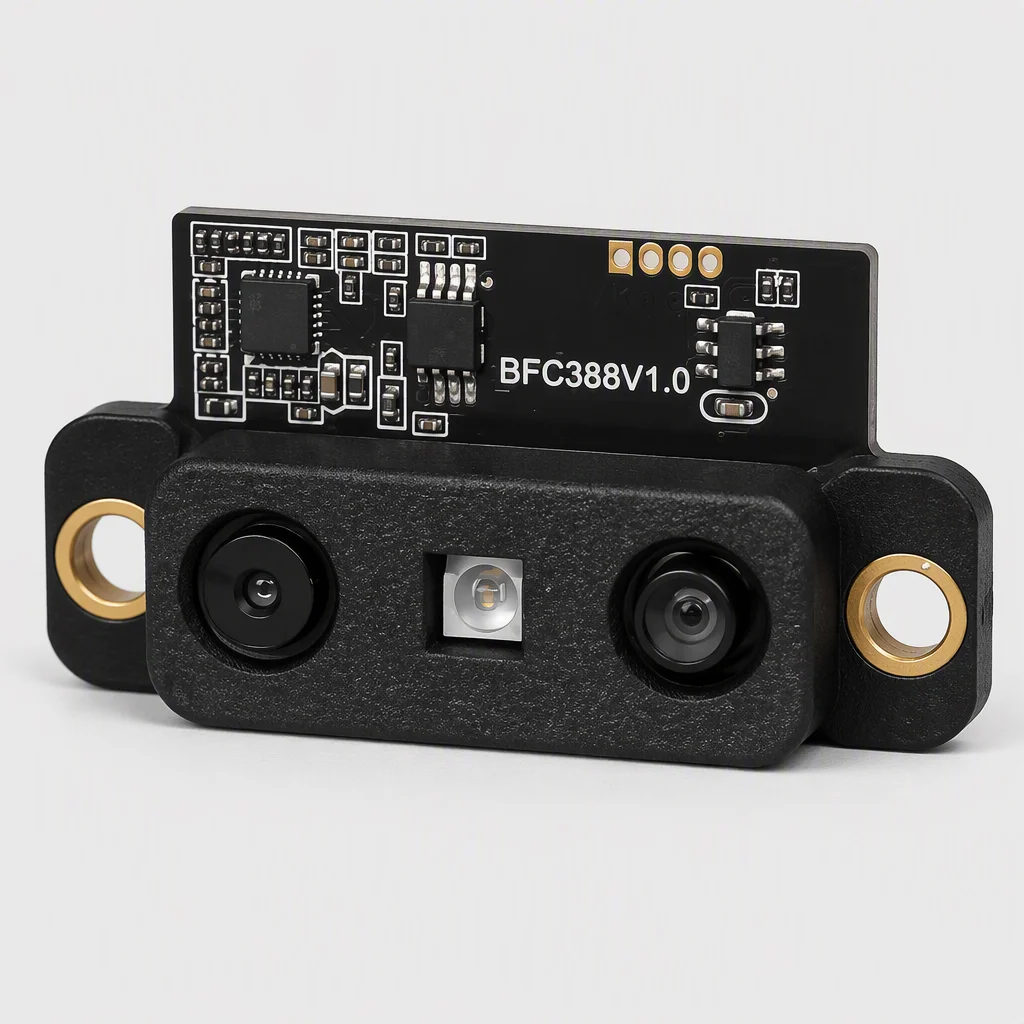
A single camera sees a photo. A single IR camera sees a photo taken in IR light. Two cameras, one RGB and one IR, see a 3D object differently — the stereo separation exposes the plane of a printout in the depth difference, which is the cheapest reliable defense in the module class we ship. The essentials stack up:
- Physical baseline — camera separation must be real hardware, not a shader effect; check the PCB drawing, not the spec sheet.
- IR fill — a 850nm-class illuminator lights the scene for the IR channel; without IR fill, evening doors turn into false-accept roulette.
- Liveness decision on-module — the compare verdict and the liveness verdict both leave the module signed, so a compromised host cannot fake a pass.
- Speed budget — the dual-path pipeline still has to complete in 0.3 s to feel native at a door.
- Anti-identity-loss engineering — good liveness chains also detect the case where the enrolled face belongs to a mask: not your problem if your vendor's module fails the photo, and it won't.
The BFC388 platform runs this dual-camera loop at 0.3 s with ±20° class head rotation and UART·USB 2.0 host paths — and the BFC800 stretches it to a 1280×720 dual-cam class with <0.001% false-accept-class figures.
Distance and height: the two hidden specs
Lock OEMs quote camera resolution first; they should quote working distance second. Children at 80 cm, adults at 170 cm, and a wheelchair user at a 120 cm door — the module's recognition envelope at 30–120 cm class sets which of those people the lock "sees". The face + palm-vein hybrid platform extends the same envelope to 0.3–1.9 m with a 1600×1200 sensor, which is the product some premium intercom OEMs use to cover both the lock and the doorbell in one module.
3D modules: what the +41% buys
Structured-light 3D adds a depth map to the intensity picture, which defeats mask attacks better than any 2D trick can. The +41% growth (2025 market reports) shows the market voting with purchase orders. For a lock, the honest trade is cost and power against attack level: 2D dual-eye stops photos and printouts dead; 3D additionally complicates physical mask spoofing. Government and finance-adjacent gates should spec 3D; residential doors where the neighbor's cat can already open anything usually don't need the top tier.
Module selection self-check
Print this five-row table as your RFQ checklist. If your supplier cannot fill every cell, you draft the wrong module.
| Check row | Ask for | Our published class |
|---|---|---|
| Liveness architecture | Dual-lens RGB+IR baseline, on-module verdict | BFC-series dual-cam liveness |
| Speed | Full-capacity 1:N time | 0.3 s |
| Capacity | User tier at terminal level | 5,000–50,000 users |
| Distance & height envelope | Min/max working distance with test photos | 30–120 cm module class; 0.3–1.9 m for vein-hybrid |
| Host path | Interface and signed-data channel | UART · USB 2.0 · RS232-class |
Terminal-level context
The same face silicon scales up: our TM-Ai face terminals take the 5,000–50,000 user tiers with DC12V 2A rails and 5–8 inch displays, and controllers hold 10,000 users / 50,000 records over TCP/IP + RS485. If you are a lock OEM in 2026, remember the door is not the only surface people expect to see themselves on — the building they enter, and the phone they carry, have already decided how identity should feel.