Why screens changed the spec sheet
Two decades ago a scanner just needed to read printed EAN-13 at a checkout. Today a delivery kiosk must read a dimmed QR from a phone at 30% brightness, a warehouse label half-curled around a drum, a C2 code on a curved retort pouch, and still make 99% of a shift's shoppers happy. The scanner market is moving accordingly: barcode scanning hardware ran at a $4.77 B scale with handhelds holding 46.8% of it, and the segment is projected toward $8 B by 2035; 2D imaging grows at 6.8–9.8% CAGR while retail-focused scanner hardware sits near $1.6 B (2025 market reports). Direction matters less than the decision: this guide is the decision.
2D vs 1D: a table, not an opinion
| Criteria | 1D CCD/laser | 2D imager |
|---|---|---|
| Data capacity | ≈20–50 chars per barcode | Hundreds to thousands of chars per QR |
| Screen codes | Not readable | Yes — dim, curved or animated |
| Damage / occlusion tolerance | Any break kills the scan | Up to 30% QR error-correction classes recover damage |
| Unreadable-at-any-angle | Must align laser to the bar | Omnidirectional — any angle within field |
| Cost | Lowest | Higher, falling as CMOS volume rises |
| Best role | Print-only, fixed lanes, minimal ROM | Anything humans or robots move |
Keep 1D for budget lanes that will never see a screen. Everything else — kiosks, self-checkout, parcel lockers, pharmacy cabinets — is 2D, and the cost gap keeps shrinking with every CMOS generation.
4mil precision: what it actually buys you
"4 mil" is the narrowest bar element width an engine can resolve — about 0.1 mm. High-density labels like Data Matrix at small print sizes, or QR vouchers printed at 300 dpi for a 12 mm tile, need it. Our in-house decode SoCs (AS732 rolling-shutter, AS733 global-shutter) hold a 99.9%+ declared decode rate class with 4 mil precision and full code-table coverage. The rule of thumb: if any label in your fleet prints below 8 mil, spec 4 mil. If everything is EAN-13 retail carton stock, 8 mil comfort is fine and cheaper.
Read distance: the maths behind the margin
Read range is not a single number; it is a curve that changes with symbol density, ambient light and print contrast. The honest way to spec it is a matrix: (a) nearest working distance — what happens at 30 mm, where the code fills the whole window; (b) farthest distance — about 150 mm for display codes, further for printed; (c) the angle envelope — our fixed engines hold ±20° class head rotation covered in firmware, so a dangling label still decodes. Kiosk builders usually care about the nearest distance most: a shopper's wrist hits a 30 mm limit constantly, and "no read at close distance" is the most-reported defect in our kiosk support log.
The five integration points
Optical window
Glass, not acrylic, above 2 mm clear aperture; anti-reflection coating when the code sits behind a screen.
Angle & tilt
Mount 10–20° off vertical so reflections bounce away from the sensor, never into it.
Power & interface
5 V logic at USB, RS232 serial for embedding; our engines run USB·RS232 and keyboard-wedge class.
Trigger strategy
Sense-trigger for kiosks (continuous is fine), shutter for handhelds — battery class 2,600 mAh / 2.4G+BT.
Host decode validation
Run the SDK's statistical routine: 100 reads of 10 symbols, log the failure per symbol type.
Three failure modes to engineer out
Mirror glare at the window
The fix is optical, not algorithmic: tilt the sensor axis, or specify a low-reflection window. Our fixed 2D engines decode ≥95% on curved QR labels in kiosk tests, but no engine reads its own reflection — that's geometry, not firmware.
Decode-trigger bleed
A continuous-scan kiosk re-decodes the same code every 200 ms — a receipt printer near the window becomes a scan-cancel machine. Use sense-trigger with a 2 s deep sleep, or an RS232 single-shot command.
Field calibration after cover replacement
Any window change alters focus. Keep the calibration pass in the production jig — the same 100-read log as in development — and never replace a scratched window without re-running it.
Engine choice by form factor
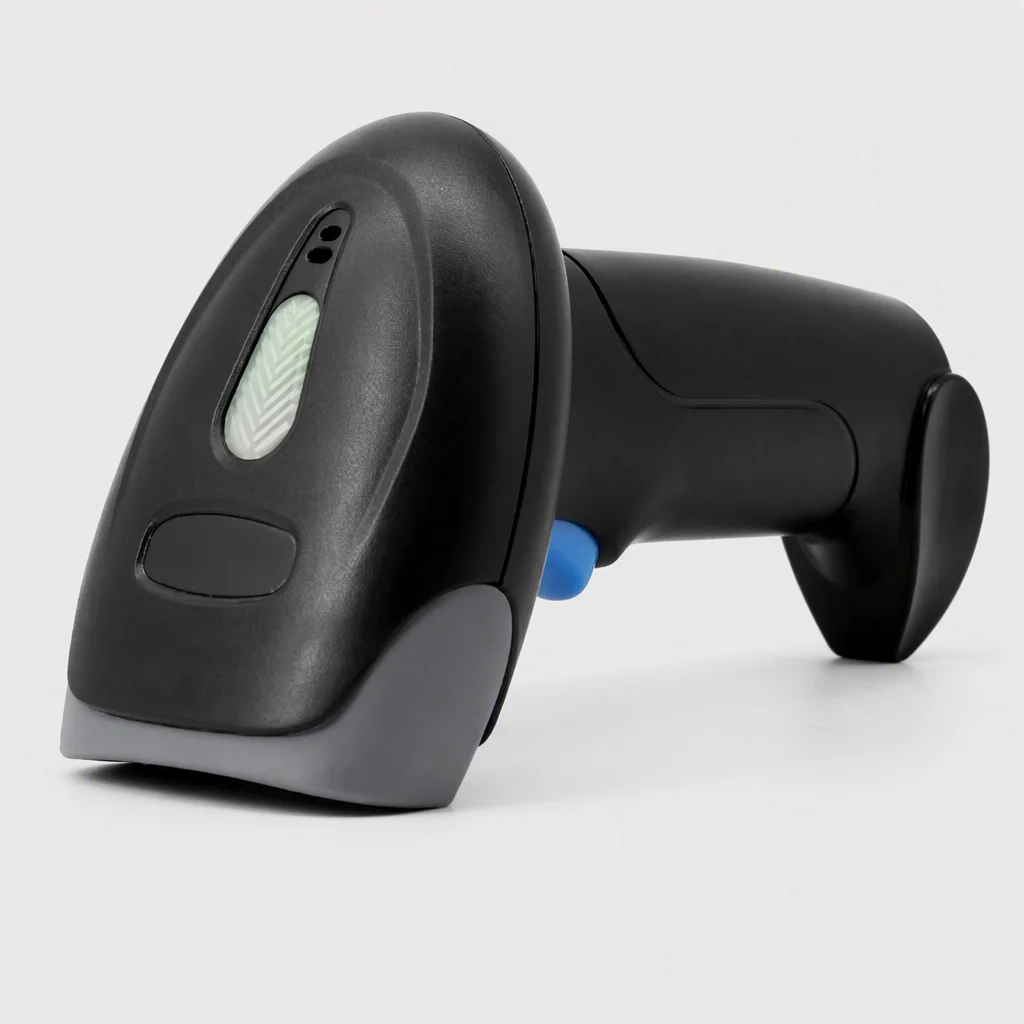
The scanner family splits four ways in our catalog: handheld guns (S/U/V/W/Y series, 47 models) for workers; fixed presentation engines (X series, 14 models) for windows and embedded panels; counter platforms (R series, 9 models) for retail desks; and voice payment boxes (R41/42/45) that announce the scanned amount aloud for street retail without a display. A wall adapter, a dangling label and a dusty counter pick different SKUs — the classification page keeps them one click apart.